When People told themselves their past with stories,
explained their present with stories,
foretold the future with stories,
the best place by the fire was kept for ...
THE STORYTELLER!!!

Posts tonen met het label ~Grimm. Alle posts tonen

~The star-money

There was once on a time a little girl whose father
and mother were dead, and she was so poor that she
no longer had any little room to live in, or bed to sleep in,
and at last she had nothing else but the clothes she
was wearing and a little bit of bread in her hand
which some charitable soul had given her.

She was, however, good and pious.
And as she was thus forsaken by all the world, she went
forth into the open country, trusting in the good God.
Then a poor man met her, who said: “Ah, give me
something to eat, I am so hungry!”
She reached him the whole of her piece of bread,
and said: “May God bless it to thy use,” and went onwards.

Then came a child who moaned and said:
“My head is so cold, give me something to cover it with.”
So she took off her hood and gave it to him; and when
she had walked a little farther,

she met another child
who had no jacket and was frozen with cold.
Then she gave it her own; and a little farther on one begged
for a frock, and she gave away that also.
At length she got into a forest and it had already become dark, and there came yet another child, and asked for
a little shirt, and the good little girl thought to herself:
“It is a dark night and no one sees thee, thou canst very
well give thy little shirt away,” and took it off, and gave
away that also.

taschengrimm 
And as she so stood, and had not one single thing left,
suddenly some stars from heaven fell down, and they were nothing else but hard smooth pieces of money,
and although she had just given her little shirt away,
she had a new one which was of the very finest linen.
Then she gathered together the money into this, and
was rich all the days of her life.

by The brothers Grimm

~The Queen Bee

Two kings' sons once went out in search of adventures, and fell into a wild, disorderly way of living, so that they never came home again.
The youngest, who was called Simpleton, set out to seek his brothers, but when at length he found them they mocked him for thinking that he with his simplicity could get through the world, when they two could not make their way, and yet were so much cleverer. They all three travelled away together, and came to an ant-hill. The two elder wanted to destroy it, to see the little ants creeping about in their terror, and carrying their eggs away,
but Simpleton said, "Leave the creatures in peace;
I will not allow you to disturb them."
Then they went onwards and came to a lake, on which a great number of ducks were swimming.
The two brothers wanted to catch a couple and roast them, but Simpleton would not permit it, and said,
" Leave the creatures in peace, I will not suffer you to kill them."
At length they came to a bee's nest, in which there was so much honey that it ran out of the trunk of the tree where it was.
The two wanted to make a fire beneath the tree, and suffocate the bees in order to take away the honey, but Simpleton again stopped them and said, "Leave the creatures in peace,
I will not allow you to burn them."

by Mervyn Peake
At length the three brothers arrived at a castle where stone horses were standing in the stables, and no human being was to be seen, and they went through all the halls until, quite at the end, they came to a door in which were three locks.
In the middle of the door, however, there was a little pane, through which they could see into the room.
There they saw a little grey man, who was sitting at a table.
They called him, once, twice, but he did not hear; at last they called him for the third time, when he got up, opened the locks, and came out. He said nothing, however, but conducted them to a handsomely-spread table, and when they had eaten and drunk,
he took each of them to a bedroom.

Next morning the little grey man came to the eldest, beckoned to him, and conducted him to a stone table, on which were inscribed three tasks, by the performance of which the castle could be delivered. The first was that in the forest, beneath the moss, lay the princess's pearls, a thousand in number, which must be picked up, and if by sunset one single pearl was wanting, he who had looked for them would be turned into stone.
The eldest went thither, and sought the whole day, but when it came to an end, he had only found one hundred, and what was written on the table came to pass, and he was changed into stone. Next day, the second brother undertook the adventure; it did not, however, fare much better with him than with the eldest;
he did not find more than two hundred pearls, and was changed to stone. At last the turn came to Simpleton also, who sought in the moss. It was, however, so hard to find the pearls, and he got on so slowly, that he seated himself on a stone, and wept.
And while he was thus sitting, the King of the ants whose life he had once saved, came with five thousand ants, and before long the little creatures had got all the pearls together, and laid them in a heap. The second task, however, was to fetch out of the lake the key of the King's daughter's bed-chamber.
When Simpleton came to the lake, the ducks which he had saved, swam up to him, dived down, and brought the key out of the water. But the third task was the most difficult; from amongst the three sleeping daughters of the King was the youngest and dearest to be sought out. They, however, resembled each other exactly, and were only to be distinguished by their having eaten different sweetmeats before they fell asleep; the eldest a bit of sugar;
the second a little syrup; and the youngest a spoonful of honey. Then the Queen of the bees, which Simpleton had protected from the fire, came and tasted the lips of all three, and at last she remained sitting on the mouth which had eaten honey, and thus the King's son recognized the right princess.

Then the enchantment was at an end; everything was released from sleep, and those who had been turned to stone received once more their natural forms. Simpleton married the youngest and sweetest princess, and after her father's death became King, and his two brothers received the two other sisters.

by The Brothers Grimm

~Hansel and Gretel

Once upon a time a very poor woodcutter lived in a tiny cottage in the forest with his two children, Hansel and Gretel.
His second wife often ill-treated the children and was forever nagging the woodcutter.
   "There is not enough food in the house for us all.
There are too many mouths to feed! We must get rid of the two brats," she declared. And she kept on trying to persuade her husband to abandon his children in the forest.
   "Take them miles from home, so far that they can never find their way back! Maybe someone will find them and give them a home." The downcast woodcutter didn't know what to do.
Hansel who, one evening, had overheard his parents' conversation, comforted Gretel.
   "Don't worry! If they do leave us in the forest, we'll find the way home," he said. And slipping out of the house he filled his pockets with little white pebbles, then went back to bed.
   All night long, the woodcutter's wife harped on and on at her husband till, at dawn, he led Hansel and Gretel away into the forest. But as they went into the depths of the trees,
Hansel dropped a little white pebble here and there on the mossy green ground. At a certain point, the two children found they really were alone: the woodcutter had plucked up enough courage to desert 
them, had mumbled an excuse and was gone.
   Night fell but the woodcutter did not return.
Gretel began to sob bitterly. Hansel too felt scared but he tried to hide his feelings and comfort his sister.

by Brünhild Schlötter   
  "Don't cry, trust me! I swear I'll take you home even if Father doesn't come back for us!" Luckily the moon was full that night and Hansel waited till its cold light filtered through the trees.
   "Now give me your hand!" he said. "We'll get home safely,
you'll see!" The tiny white pebbles gleamed in the moonlight, and the children found their way home. They crept through a half open window, without wakening their parents. Cold, tired but thankful to be home again, they slipped into bed.
   Next day, when their stepmother discovered that Hansel and Gretel had returned, she went into a rage.
Stifling her anger in front of the children, she locked her bedroom door, reproaching her husband for failing to carry out her orders. The weak woodcutter protested, torn as he was between shame and fear of disobeying his cruel wife. The wicked stepmother kept Hansel and Gretel under lock and key all day with nothing for supper but a sip of water and some hard bread. All night, husband and wife quarreled, and when dawn came, the woodcutter led the children out into the forest.
   Hansel, however, had not eaten his bread, and as he walked through the trees, he left a trail of crumbs behind him to mark the way. But the little boy had forgotten about the hungry birds that lived in the forest. When they saw him, they flew along behind and in no time at all, had eaten all the crumbs.
Again, with a lame excuse, the woodcutter left his
two children by  themselves.

   "I've left a trail, like last time!" Hansel whispered to Gretel, consolingly. But when night fell, they saw to their horror, that all the crumbs had gone.
   "I'm frightened!" wept Gretel bitterly. "I'm cold and hungry and I want to go home!"
   "Don't be afraid. I'm here to look after you!" Hansel tried to encourage his sister, but he too shivered when he glimpsed frightening shadows and evil eyes around them in the darkness. All night the two children huddled together for warmth at the foot of a large tree.
   When dawn broke, they started to wander about the forest, seeking a path, but all hope soon faded. They were well and truly lost. On they walked and walked, till suddenly they came upon a strange cottage in the middle of a glade.
   "This is chocolate!" gasped Hansel as he broke a lump of plaster from the wall.
   "And this is icing!" exclaimed Gretel, putting another piece of wall in her mouth. Starving but delighted, the children began to eat pieces of candy broken off the cottage.
   "Isn't this delicious?" said Gretel, with her mouth full.
She had never tasted anything so nice.
   "We'll stay here," Hansel declared, munching a bit of nougat. They were just about to try a piece of the biscuit door when it quietly swung open.
   "Well, well!" said an old woman, peering out with a crafty look. "And haven't you children a sweet tooth?"
   "Come in! Come in, you've nothing to fear!" went on the old woman. Unluckily for Hansel and Gretel, however, the sugar candy cottage belonged to an old witch, her trap for catching unwary victims. The two children had come to a really nasty place.
   "You're nothing but skin and bones!" said the witch, locking Hansel into a cage. I shall fatten you up and eat you!"
   "You can do the housework," she told Gretel grimly,
"then I'll make a meal of you too!" As luck would have it, the witch had very bad eyesight, an when Gretel smeared butter on her glasses, she could see even less.
   "Let me feel your finger!" said the witch to Hansel every day to check if he was getting any fatter. Now, Gretel had brought her brother a chicken bone, and when the witch went to touch his finger, Hansel held out the bone.
   "You're still much too thin!" she complained.
When will you become plump?" One day the witch grew tired of waiting.
   "Light the oven," she told Gretel. "We're going to have a tasty roasted boy today!" A little later, hungry and impatient, she went on: "Run and see if the oven is hot enough." Gretel returned, whimpering: "I can't tell if it is hot enough or not." Angrily, the witch screamed at the little girl: "Useless child! All right, I'll see for myself." But when the witch bent down to peer inside the oven and check the heat, Gretel gave her a tremendous push and slammed the oven door shut. The witch had come to a fit and proper end. Gretel ran to set her brother free and they made quite sure that the oven door was tightly shut behind the witch. Indeed, just to be on the safe side, they fastened it firmly with a large padlock. Then they stayed for several days to 
eat some more of the house, till they discovered amongst the witch's belongings, a huge chocolate egg. Inside lay a casket of gold coins.

   "The witch is now burnt to a cinder," said Hansel, "so we'll take this treasure with us." They filled a large basket with food and set off into the forest to search for the way home.
This time, luck was with them, and on the second day, they saw their father come out of the house towards them, weeping.
   "Your stepmother is dead. Come home with me now, my dear children!" The two children hugged the woodcutter.
   "Promise you'll never ever desert us again," said Gretel,
throwing her arms round her father's neck. Hansel opened the casket.
   "Look, Father! We're rich now . . . You'll never have to chop wood again."
   And they all lived happily together ever after.

by The Brothers Grimm

~The Goose Girl

The Goose-Girl There was once upon a time
an old Queen whose husband had been dead for many years,
and she had a beautiful daughter.
When the princess grew up she was betrothed to a prince who lived at a great distance. When the time came for her to be married, and she had to journey forth into the distant kingdom, the aged Queen packed up for her many costly vessels of silver and gold, and trinkets also of gold and silver; and cups and jewels - in short, everything which appertained to a royal dowry,
for she loved her child with all her heart.
She likewise sent her maid-in-waiting, who was to ride with her, and hand her over to the bridegroom, and each had a horse for the journey, but the horse of the King's daughter was called Falada, and could speak. So when the hour of parting had come, the aged mother went into her bedroom, took a small knife and cut her finger with it until it bled, then she held a white handkerchief to it into which she let three drops of blood fall, gave it to her daughter and said, "Dear child, preserve this carefully, it will be of service to you on your way."

So they took a sorrowful leave of each other; the princess put the piece of cloth in her bosom, mounted her horse,
and then went away to her bridegroom.
After she had ridden for a while she felt a burning thirst, and said to her waiting-maid. "Dismount, and take my cup which thou hast brought with thee for me, and get me some water from the stream, for I should like to drink." "If you are thirsty," said the waiting-maid, "get off your horse yourself, and lie down and drink out of the water, I don't choose to be your servant."
So in her great thirst the princess alighted, bent down over the water in the stream and drank, and was not allowed to drink out of the golden cup. Then she said, "Ah, Heaven!" and the three drops of blood answered, "If thy mother knew this, her heart would break,"
But the King's daughter was humble, said nothing, and mounted her horse again. She rode some miles further, but the day was warm, the sun scorched her, and she was thirsty once more,
and when they came to a stream of water, she again cried to her waiting - maid, "Dismount and give me some water in my golden cup," for she had long ago forgotten the girl's ill words.
But the waiting-maid said still more haughtily, "If you wish to drink, drink as you can, I don't choose to be your maid."
Then in her great thirst the King's daughter alighted, bent over the flowing stream, wept and said, "Ah, Heaven!" and the drops of blood again replied, "If thy mother knew this, her heart would break." And as she was thus drinking and leaning right over the stream, the handkerchief with the three drops of blood fell out of her bosom, and floated away with the water without her observing it, so great was her trouble.

Willy Pogany 
The waiting-maid, however, had seen it, and she rejoiced to think that she had now power over the bride, for since the princess had lost the drops of blood, she had become weak and powerless.
So now when she wanted to mount her horse again, the one that was called Falada, the waiting-maid said, "Falada is more suitable for me, and my nag will do for thee," and the princess had to be content with that. Then the waiting-maid, with many hard words, bade the princess exchange her royal apparel for her own shabby clothes; and at length she was compelled to swear by the clear sky above her, that she would not say one word of this to anyone at the royal court, and if she had not taken this oath she would have been killed on the spot. But Falada saw all this, and observed it well. The waiting-maid now mounted Falada, and the true bride the bad horse, and thus they travelled onwards, until at length they entered the royal palace.
There were great rejoicings over her arrival, and the prince sprang forward to meet her, lifted the waiting-maid from her horse, and thought she was his consort. She was conducted upstairs, but the real princess was left standing below.
Then the old king looked out of the window and saw her standing in the courtyard, and saw how dainty and delicate and beautiful she was, and instantly went to the royal apartment, and asked the bride about the girl she had with her who was standing down below in the courtyard, and who she was?
"I picked her up on my way for a companion; give the girl something to work at, that she may not stand idle."
But the old King had no work for her, and knew of none, so he said, "I have a little boy who tends the geese, she may help him." The boy was called Conrad, and the true bride had to help him to tend the geese. Soon afterwards the false bride said to the young King, "Dearest husband, I beg you to do me a favour."
He answered. "I will do so most willingly." "Then send for the knacker, and have the head of the horse on which I rode here cut off, for it vexed me on the way." In reality, she was afraid that the horse might tell how she had behaved to the King's daughter. Then she succeeded in making the King promise that it should be done, and the faithful Falada was to die; this came to the ears of the real princess, and she secretly promised to pay the knacker a piece of gold if he would perform a small service for her.
There was a great dark-looking gateway in the town, through which morning and evening she had to pass with the geese: would he be so good as to nail up Falada's head on it, so that she might see him again, more than once. The knacker's man promised to do that, and cut off the head, and nailed it fast beneath the dark gateway.

Early in the morning, when she and Conrad drove out their flock beneath this gateway, she said in passing,
"Alas, Falada, hanging there!" Then the head answered,
"Alas, young Queen, how ill you fare! If this your tender mother knew, Her heart would surely break in two."

Then they went still further out of the town, and drove their geese into the country. And when they had come to the meadow, she sat down and unbound her hair which was like pure gold, and Conrad saw it and delighted in its brightness, and wanted to pluck out a few hairs.

Then she said, "Blow, blow, thou gentle wind, I say, Blow Conrad's little hat away, And make him chase it here and there, Until I have braided all my hair, And bound it up again."

And there came such a violent wind that it blew Conrad's hat far away across country, and he was forced to run after it.
When he came back she had finished combing her hair and was putting it up again, and he could not get any of it.
Then Conrad was angry, and would not speak to her, and thus they watched the geese until the evening, and then they went home.

Next day when they were driving the geese out through the dark gateway, the maiden said, "Alas, Falada, hanging there!"
Falada answered, "Alas, young Queen, how ill you fare! If this your tender mother knew, Her heart would surely break in two." And she sat down again in the field and began to comb out her hair, and Conrad ran and tried to clutch it, so she said in haste, "Blow, blow, though gentle wind, I say, Blow Conrad's little hat away, And make him chase it here and there, Until I have braided all my hair, And bound it up again."

Then the wind blew, and blew his little hat off his head and far away, and Conrad was forced to run after it, and when he came back, her hair had been put up a long time, and he could get none of it, and so they looked after their geese till evening came.
But in the evening after they had got home, Conrad went to the old King, and said, "I won't tend the geese with that girl any longer!" "Why not?" inquired the aged King.
"Oh, because she vexes me the whole day long."
Then the aged King commanded him to relate what it was that she did to him. And Conrad said, "In the morning when we pass beneath the dark gateway with the flock, there is a sorry horse's head on the wall, and she says to it, "Alas, Falada, hanging there!" And the head replies, "Alas, young Queen, how ill you fare!
If this your tender mother knew, Her heart would surely break in two." And Conrad went on to relate what happened on the goose pasture, and how when there he had to chase his hat.

The aged King commanded him to drive his flock out again next day, and as soon as morning came, he placed himself behind the dark gateway, and heard how the maiden spoke to the head of Falada, and then he too went into the country, and hid himself in the thicket in the meadow. There he soon saw with his own eyes the goose-girl and the goose-boy bringing their flock, and how after a while she sat down and unplaited her hair, which shone with radiance. And soon she said, "Blow, blow, thou gentle wind,
I say, Blow Conrad's little hat away, And make him chase it here and there, Until I have braided all my hair, And bound it up again." Then came a blast of wind and carried off Conrad's hat,
so that he had to run far away, while the maiden quietly went on combing and plaiting her hair, all of which the King observed. Then, quite unseen, he went away, and when the goose-girl came home in the evening, he called her aside, and asked why she did all these things. "I may not tell you that, and I dare not lament my sorrows to any human being, for I have sworn not to do so by the heaven which is above me; if I had not done that, I should have lost my life." He urged her and left her no peace, but he could draw nothing from her.

Then said he, "If thou wilt not tell me anything, tell thy sorrows to the iron-stove there," and he went away.
Then she crept into the iron-stove, and began to weep and lament, and emptied her whole heart, and said, "Here am I deserted by the whole world, and yet I am a King's daughter, and a false waiting-maid has by force brought me to such a pass that I have been compelled to put off my royal apparel, and she has taken my place with my bridegroom, and I have to perform menial service as a goose-girl. If my mother did but know that, her heart would break." The aged King, however, was standing outside by the pipe of the stove, and was listening to what she said, and heard it. Then he came back again, and bade her come out of the stove. And royal garments were placed on her,
and it was marvellous how beautiful she was!

The aged King summoned his son, and revealed to him that he had got the false bride who was only a waiting-maid, but that the true one was standing there, as the sometime goose-girl. The young King rejoiced with all his heart when he saw her beauty and youth, and a great feast was made ready to which all the people and all good friends were invited. At the head of the table sat the bridegroom with the King's daughter at one side of him, and the waiting-maid on the other, but the waiting - maid was blinded, and did not recognize the princess in her dazzling array.
When they had eaten and drunk, and were merry, the aged King asked the waiting - maid as a riddle, what a person deserved who had behaved in such and such a way to her master, and at the same time related the whole story, and asked what sentence such an one merited? Then the false bride said: "She deserves no better fate than to be stripped entirely naked, and put in a barrel which is studded inside with pointed nails, and two white horses should be harnessed to it, which will drag her along through one street after another, till she is dead." "It is thou," said the aged King, "
and thou hast pronounced thine own sentence, and thus shall it be done unto thee."
And when the sentence had been carried out, the young King married his true bride, and both of them reigned over their kingdom in peace and happiness.

by |The Brothers Grimm

~Pinocchio

Once upon a time...

a carpenter picked up a strange chunk of wood one day while mending a table. When he began to chip it, the wood started to moan. This frightened the carpenter and he decided to get rid of it at once, so he gave it to a friend called Geppetto, who wanted to make a puppet.

Geppetto, a cobbler, took his lump of wood home, thinking about the name he would give his puppet.

"I'll call him Pinocchio," he told himself. "It's a lucky name." Back in his humble basement home and workshop, Geppetto started to carve the wood. Suddenly a voice squealed:

"Ooh! That hurt!" Geppetto was astonished to find that the wood was alive. Excitedly he carved a head, hair and eyes, which immediately stared right at the cobbler. But the second Geppetto carved out the nose, it grew longer and longer, and no matter how often the cobbler cut it down to size, it just stayed a long nose. The newly cut mouth began to chuckle and when Geppetto angrily complained, the puppet stuck out his tongue at him.
That was nothing, however! When the cobbler shaped the hands, they snatched the good man's wig, and the newly carved legs gave him a hearty kick. His eyes brimming with tears, Geppetto scolded the puppet.

Pinocchio by Luigi and Maria Augusta Cavalieri (1924)

"You naughty boy! I haven't even finished making you, yet you've no respect for your father!" Then he picked up the puppet and, a step at a time, taught him to walk. But the minute Pinocchio stood upright, he started to run about the room, with Geppetto after him, then he opened the door and dashed into the street.
Now, Pinocchio ran faster than Geppetto and though the poor cobbler shouted "Stop him! Stop him!" none of the onlookers, watching in amusement, moved a finger. Luckily, a policeman heard the cobbler's shouts and strode quickly down the street. Grabbing the runaway, he handed him over to his father.

"I'll box your ears," gasped Geppetto, still out of breath.
Then he realized that was impossible, for in his haste to carve the puppet, he had forgotten to make his ears. Pinocchio had got a fright at being in the clutches of the police, so he apologized and Geppetto forgave his son.

Indeed, the minute they reached home, the cobbler made Pinocchio a suit out of flowered paper, a pair of bark shoes and a soft bread hat. The puppet hugged his father.

"I'd like to go to school," he said, "to become clever and help you when you're old!" Geppetto was touched by this kind thought.

"I'm very grateful," he replied, "but we haven't enough money even to buy you the first reading book!" Pinocchio looked downcast, then Geppetto suddenly rose to his feet, put on his old tweed coat and went out of the house. Not long after he returned carrying a first reader, but minus his coat. It was snowing outside.

"Where's your coat, father?" "I sold it."
"Why did you sell it?"
"It kept me too warm!"
Pinocchio threw his arms round Geppetto's neck and kissed the kindly old man.

It had stopped snowing and Pinocchio set out for school with his first reading book under his arm. He was full of good intentions. "Today I want to learn to read. Tomorrow I'll learn to write and the day after to count. Then I'll earn some money and buy Geppetto a fine new coat. He deserves it, for . . ." The sudden sound of a brass band broke into the puppet's daydream and he soon forgot all about school. He ended up in a crowded square where people were clustering round a brightly colored booth.

"What's that?" he asked a boy.
"Can't you read? It's the Great Puppet Show!"
"How much do you pay to go inside?"

"Fourpence.'

"Who'll give me fourpence for this brand new book?" Pinocchio cried. A nearby junk seller bought the reading book and Pinocchio hurried into the booth. Poor Geppetto. His sacrifice had been quite in vain. Hardly had Pinocchio got inside, when he was seen by one of the puppets on the stage who cried out: "There's Pinocchio! There's Pinocchio!"

"Come, along. Come up here with us. Hurrah for brother Pinocchio!" cried the puppets. Pinocchio went onstage with his new friends, while the spectators below began to mutter about uproar. Then out strode Giovanni, the puppet- master, a frightful looking man with fierce bloodshot eyes.

"What's going on here? Stop that noise! Get in line, or you'll hear about it later!"

That evening, Giovanni sat down to his meal, but when he found that more wood was needed to finish cooking his nice chunk of meat, he remembered the intruder who had upset his show.

"Come here, Pinocchio! You'll make good firewood!" The poor puppet started to weep and plead.
"Save me, father! I don't want to die . . . I don't want to die!"
When Giovanni heard Pinocchio's cries, he was surprised.
"Are your parents still alive?" he asked.
"My father is, but I've never known my mother," said the puppet in a low voice. The big man's heart melted.
"It would be beastly for your father if I did throw you into the fire . . . but I must finish roasting the mutton. I'll just have to burn another puppet. Men! Bring me Harlequin, trussed!" When Pinocchio saw that another puppet was going to be burned in his place, he wept harder than ever.
"Please don't, sir! Oh, sir, please don't! Don't burn Harlequin!"

"That's enough!" boomed Giovanni in a rage. "I want my meat well cooked!" "In that case," cried Pinocchio defiantly, rising to his feet, "burn me! It's not right that Harlequin should be burnt instead ofme!"

Giovanni was taken aback. "Well, well!" he said. "I've never met a puppet hero before!" Then he went on in a milder tone. "You really are a good lad. I might indeed . . ." Hope flooded Pinocchio's heart as the puppet- master stared at him, then at last the man said: "All right! I'll eat half raw mutton tonight, but next time, somebody will find himself in a pickle." All the puppets were delighted at being saved. Giovanni asked Pinocchio to tell him the whole tale, and feeling sorry for kindhearted Geppetto, he gave the puppet five gold pieces. 

"Take these to your father," he said. "Tell him to buy himself a new coat, and give him my regards."

Pinocchio cheerfully left the puppet booth after thanking Giovanni for being so generous. He was hurrying homewards when he met a half blind cat and a lame fox. He couldn't help but tell them all about his good fortune, and when the pair set eyes on the gold coins, they hatched a plot, saying to Pinocchio:

"If you would really like to please your father, you ought to take him a lot more coins. Now, we know of a magic meadow where you can sow these five coins. The next day, you will find they have become ten times as many!"

"How can that happen?" asked Pinocchio in amazement.
"I'll tell you how!" exclaimed the fox. "In the land of Owls lies a meadow known as Miracle Meadow. If you plant one gold coin in a little hole, next day you will find a whole tree dripping with gold coins!"

Pinocchio drank in every word his two "friends" uttered and off they all went to the Red Shrimp Inn to drink to their meeting and future wealth.
After food and a short rest, they made plans to leave at midnight for Miracle Meadow. However, when Pinocchio was wakened by the innkeeper at the time arranged, he found that the fox and the cat had already left. All the puppet could do then was pay for the dinner, using one of his gold coins, and set off alone along the path through the woods to the magic meadow. Suddenly...

"Your money or your life!" snarled two hooded bandits. Now, Pinocchio had hidden the coins under his tongue, so he could not say a word, and nothing the bandits could do would make Pinocchio tell where the coins were hidden. Still mute, even when the wicked pair tied a noose round the poor puppet's neck and pulled it tighter and tighter, Pinocchio's last thought was "Father, help me!"

Of course, the hooded bandits were the fox and the cat. "You'll hang there," they said, "till you decide to talk. We'll be back soon to see if you have changed your mind!" And away they went.

However, a fairy who lived nearby had overheard everything . . . From the castle window, the Turquoise Fairy saw a kicking puppet dangling from an oak tree in the wood. Taking pity on him, she clapped her hands three times and suddenly a hawk and a dog appeared.

"Quickly!" said the fairy to the hawk. "Fly to that oak tree and with your beak snip away the rope round the poor lad's neck!"
To the dog she said: "Fetch the carriage and gently bring him to me!"

In no time at all, Pinocchio, looking quite dead, was lying in a cozy bed in the castle, while the fairy called three famous doctors, crow, owl and cricket. A very bitter medicine, prescribed by these three doctors quickly cured the puppet, then as she caressed him, the fairy said: "Tell me what happened!"

Pinocchio told her his story, leaving out the bit about selling his first reading book, but when the fairy asked him where the gold coins were, the puppet replied that he had lost them. In fact, they were hidden in one of his pockets. All at once, Pinocchio's nose began to stretch, while the fairy laughed.

"You've just told a lie! I know you have, because your nose is growing longer!" Blushing with shame, Pinocchio had no idea what to do with such an ungainly nose and he began to weep.
However, again feeling sorry for him, the fairy clapped her hands and a flock of woodpeckers appeared to peck his nose back to its proper length.

"Now, don't tell any more lies," the fairy warned him," or your nose will grow again! Go home and take these coins to your father."

Pinocchio gratefully hugged the fairy and ran off homewards.
But near the oak tree in the forest, he bumped into the cat and the fox. Breaking his promise, he foolishly let himself be talked into burying the coins in the magic meadow. Full of hope, he returned next day, but the coins had gone. Pinocchio sadly trudged home without the coins Giovanni had given him for his father.

After scolding the puppet for his long absence, Geppetto forgave him and off he went to school. Pinocchio seemed to have calmed down a bit. But someone else was about to cross his path and lead him astray. This time, it was Carlo, the lazy bones of the class.

"Why don't you come to Toyland with me?" he said. "Nobody ever studies there and you can play all day long!"
"Does such a place really exist?" asked Pinocchio in amazement. "The wagon comes by this evening to take me there," said Carlo.  "Would you like to come?"

Forgetting all his promises to his father and the fairy, Pinocchio was again heading for trouble. Midnight struck, and the wagon arrived to pick up the two friends, along with some other lads who could hardly wait to reach a place where schoolbooks and teachers had never been heard of. Twelve pairs of donkeys pulled the wagon, and they were all shod with white leather boots.
The boys clambered into the wagon. Pinocchio, the most excited of them all, jumped on to a donkey. Toyland, here we come!

Now Toyland was just as Carlo had described it: the boys all had great fun and there were no lessons. You weren't even allowed to whisper the word "school", and Pinocchio could hardly believe he was able to play allthe time.

"This is the life!" he said each time he met Carlo.
"I was right, wasn't I?" exclaimed his friend, pleased with himself.
"Oh, yes Carlo! Thanks to you I'm enjoying myself. And just think: teacher told me to keep well away from you."

One day, however, Pinocchio awoke to a nasty surprise.
When he raised a hand to his head, he found he had sprouted a long pair of hairy ears, in place of the sketchy ears that Geppetto had never got round to finishing. And that wasn't all!
The next day, they had grown longer than ever. Pinocchio shamefully pulled on a large cotton cap and went off to search for Carlo. He too was wearing a hat, pulled right down to his nose. With the same thought in their heads, the boys stared at each other, then snatching off their hats, they began to laugh at the funny sight of long hairy ears. But as they screamed with laughter, Carlo suddenly went pale and began to stagger. "Pinocchio, help! Help!" But Pinocchio himself was stumbling about and he burst into tears. For their faces were growing into the shape of a donkey's head and they felt themselves go down on all fours. Pinocchio and Carlo were turning into a pair of donkeys. And when they tried to groan with fear, they brayed loudly instead. When the Toyland wagon driver heard the braying of his new donkeys, he rubbed his hands in glee.

"There are two fine new donkeys to take to market. I'll get at least four gold pieces for them!" For such was the awful fate that awaited naughty little boys that played truant from school to spend all their time playing games.

Carlo was sold to a farmer, and a circus man bought Pinocchio to teach him to do tricks like his other performing animals. It was a hard life for a donkey! Nothing to eat but hay, and when that was gone, nothing but straw. And the beatings! Pinocchio was beaten every day till he had mastered the difficult circus tricks. One day, as he was jumping through the hoop, he stumbled and went lame. The circus man called the stable boy.

"A lame donkey is no use to me," he said. "Take it to market and get rid of it at any price!" But nobody wanted to buy a useless donkey. Then along came a little man who said: "I'll take it for the skin. It will make a good drum for the village band!"

And so, for a few pennies, Pinocchio changed hands and he brayed sorrowfully when he heard what his awful fate was to be. The puppet's new owner led him to the edge of the sea, tied a large stone to his neck, and a long rope round Pinocchio's legs and pushed him into the water. Clutching the end of the rope, the man sat down to wait for Pinocchio to drown. Then he would flay off the donkey's skin.

Pinocchio struggled for breath at the bottom of the sea, and in a flash, remembered all the bother he had given Geppetto, his broken promises too, and he called on the fairy.

The fairy heard Pinocchio's call and when she saw he was about to drown, she sent a shoal of big fish. They ate away all the donkey flesh, leaving the wooden Pinocchio. Just then, as the fish stopped nibbling, Pinocchio felt himself hauled out of the water. And the man gaped in astonishment at the living puppet, twisting and turning like an eel, which appeared in place of the dead donkey. When he recovered his wits, he babbled, almost in tears: "Where's the donkey I threw into the sea?"

"I'm that donkey", giggled Pinocchio.
"You!" gasped the man. "Don't try pulling my leg. If I get angry . . ."
However, Pinocchio told the man the whole story . . . "and that's how you come to have a live puppet on the end of the rope instead of a dead donkey!"

"I don't give a whit for your story," shouted the man in a rage.
"All I know is that I paid twenty coins for you and I want my money back! Since there's no donkey, I'll take you to market and sell you as firewood!"

By then free of the rope, Pinocchio made a face at the man and dived into the sea. Thankful to be a wooden puppet again, Pinocchio swam happily out to sea and was soon just a dot on the horizon. But his adventures were far from over. Out of the water behind him loomed a terrible giant shark! A horrified Pinocchio saw its wide open jaws and tried to swim away as fast as he could, but the monster only glided closer. Then the puppet tried to escape by going in the other direction, but in vain. He could never escape the shark, for as the water rushed into its cavern like mouth, he was sucked in with it. And in an instant Pinocchio had been swallowed along with shoals of fish unlucky enough to be in the fierce creature's path. Down he went, tossed in the torrent of water as it poured down the shark's throat, till he felt dizzy.
When Pinocchio came to his senses, he was in darkness.
Over his head, he could hear the loud heave of the shark's gills.
On his hands and knees, the puppet crept down what felt like a sloping path, crying as he went:
"Help! Help! Won't anybody save me?"

Suddenly, he noticed a pale light and, as he crept towards it, he saw it was a flame in the distance. On he went, till: "Father! It can't be you! . . "Pinocchio! Son! It really is you . . ."

Weeping for joy, they hugged each other and, between sobs, told their adventures. Geppetto stroked the puppet's head and told him how he came to be in the shark's stomach.

"I was looking for you everywhere. When I couldn't find you on dry land, I made a boat to search for you on the sea. But the boat capsized in a storm, then the shark gulped me down.
Luckily, it also swallowed bits of ships wrecked in the tempest, so I've managed to survive by getting what I could from these!"

"Well, we're still alive!" remarked Pinocchio, when they had finished recounting their adventures. "We must get out of here!"

Taking Geppetto's hand, the pair started to climb up the shark's stomach, using a candle to light their way.
When they got as far as its jaws, they took fright, but as so happened, this shark slept with its mouth open, for it suffered from asthma.

As luck would have it, the shark had been basking in shallow waters since the day before, and Pinocchio soon reached the beach. Dawn was just breaking, and Geppetto, soaked to the skin, was half dead with cold and fright.

"Lean on me, father." said Pinocchio. "I don't know where we are, but we'll soon find our way home!"

Beside the sands stood an old hut made of branches, and there they took shelter. Geppetto was running a temperature, but Pinocchio went out, saying, "I'm going to get you some milk."
The bleating of goats led the puppet in the right direction, and he soon came upon a farmer. Of course, he had no money to pay for the milk.

"My donkey's dead," said the farmer. "If you work the treadmill from dawn to noon, then you can have some milk." And so, for days on end, Pinocchio rose early each morning to earn Geppetto's food.

At long last, Pinocchio and Geppetto reached home.
The puppet worked late into the night weaving reed baskets to make money for his father and himself. One day, he heard that the fairy after a wave of bad luck, was ill in hospital. So instead of buying himself a new suit of clothes, Pinocchio sent the fairy the money to pay for her treatment.

One night, in a wonderful dream, the fairy appeared to reward Pinocchio for his kindness. When the puppet looked in the mirror next morning, he found he had turned into somebody else. For there in the mirror, was a handsome young lad with blue eyes and brown hair. Geppetto hugged him happily.

"Where's the old wooden Pinocchio?" the young lad asked in astonishment. "There!" exclaimed Geppetto, pointing at him. "When bad boys become good, their looks change along with their lives!"

By The Brothers Grimm

~The Pied Piper of Hamelin

Once upon a time...

on the banks of a great river in the north of Germany lay a town called Hamelin. The citizens of Hamelin were honest folk who lived contentedly in their Grey stone houses. The years went by, and the town grew very rich.

Then one day, an extraordinary thing happened to disturb the peace.

Hamelin had always had rats, and a lot too. But they had never been a danger, for the cats had always solved the rat problem in the usual way- by killing them. All at once, however, the rats began to multiply.

In the end, a black sea of rats swarmed over the whole town. First, they attacked the barns and storehouses, then, for lack of anything better, they gnawed the wood, cloth or anything at all. The one thing they didn't eat was metal. The terrified citizens flocked to plead with the town councilors to free them from the plague of rats. But the council had, for a long time, been sitting in the Mayor's room, trying to think of a plan.

"What we need is an army of cats!"
But all the cats were dead.
"We'll put down poisoned food then . . ."
But most of the food was already gone and even poison did not stop the rats.

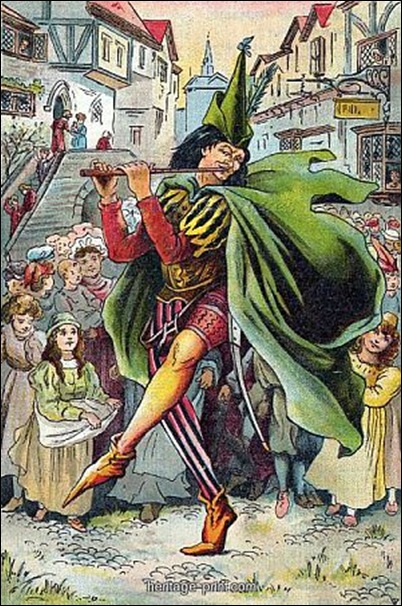
the_pied_piper_leading_away_the_children_of_hamelin_c1899

"It just can't be done without help!" said the Mayor sadly.

Just then, while the citizens milled around outside, there was a loud knock at the door. "Who can that be?" the city fathers wondered uneasily, mindful of the angry crowds. They gingerly opened the door. And to their surprise, there stood a tall thin man dressed in brightly colored clothes, with a long feather in his hat, and waving a gold pipe at them.

"I've freed other towns of beetles and bats," the stranger announced, "and for a thousand florins, I'll rid you of your rats!"

"A thousand florins!" exclaimed the Mayor. "We'll give you fifty thousand if you succeed!" At once the stranger hurried away, saying:

"It's late now, but at dawn tomorrow, there won't be a rat left in Hamelin!"
The sun was still below the horizon, when the

sound of a pipe wafted through the streets of Hamelin. The pied piper slowly made his way through the houses and behind him flocked the rats. Out they scampered from doors, windows and gutters, rats of every size, all after the piper. And as he played, the stranger marched down to the river and straight into the water, up to his middle. Behind him swarmed the rats and every one was drowned and swept away by the current.

By the time the sun was high in the sky, there was not a single rat in the town. There was even greater delight at the town hall, until the piper tried to claim his payment.

"Fifty thousand florins?" exclaimed the councilors,
"Never..."
" A thousand florins at least!" cried the pied piper angrily. But the Mayor broke in. "The rats are all dead now and they can never come back. So be grateful for fifty florins, or you'll not get even that . . ."

His eyes flashing with rage, the pied piper pointed a threatening finger at the Mayor.
"You'll bitterly regret ever breaking your promise," he said, and vanished.

A shiver of fear ran through the councilors, but the Mayor shrugged and said excitedly: "We've saved fifty thousand florins!"

That night, freed from the nightmare of the rats, the citizens of Hamelin slept more soundly than ever. And when the strange sound of piping wafted through the streets at dawn, only the children heard it. Drawn as by magic, they hurried out of their homes. Again, the pied piper paced through the town, this time, it was children of all sizes that flocked at his heels to the sound of his strange piping.

The long procession soon left the town and made its way through the wood and across the forest till it reached the foot of a huge mountain. When the piper came to the dark rock, he played his pipe even louder still and a great door creaked open. Beyond lay a cave. In trooped the children behind the pied piper, and when the last child had gone into the darkness, the door creaked shut.

A great landslide came down the mountain blocking the entrance to the cave forever. Only one little lame boy escaped this fate. It was he who told the anxious citizens, searching for their children, what had

happened. And no matter what people did, the mountain never gave up its victims. 

Many years were to pass before the merry voices of other children would ring through the streets of Hamelin but the memory of the harsh lesson lingered in everyone's heart and was passed down from father to son through the centuries.

By the Brothers Grimm

~Fitcher's Bird

Once upon a time there was a sorcerer who disguised himself as a poor man, went begging from house to house, and captured beautiful girls. No one knew where he took them, for none of them ever returned.

One day he came to the door of a man who had three beautiful daughters. He appeared to be a poor, weak beggar, and he carried a pack basket on his back, as though he wanted to collect some benevolent offerings in it. He asked for a bit to eat, and when the oldest daughter came out to give him a piece of bread, he simply touched her, and she was forced to jump into his pack basket. Then he hurried away with powerful strides and carried her to his house, which stood in the middle of a dark forest.

Everything was splendid in the house, and he gave her everything that she wanted. He said, "My dear, you will like it here with me. You will have everything that your heart desires."

So it went for a few days, and then he said to her, "I have to go away and leave you alone for a short time. Here are the house keys. You may go everywhere and look at everything except for the one room that this little key here unlocks. I forbid you to go there on the penalty of death."

He also gave her an egg, saying, "Take good care of this egg.
You should carry it with you at all times, for if you should loose it great misfortune would follow."

She took the keys and the egg, and promised to take good care of everything.

As soon as he had gone she walked about in the house from top to bottom examining everything. The rooms glistened with silver and gold, and she thought that she had never seen such splendor.

Finally she came to the forbidden door. She wanted to pass it by, but curiosity gave her no rest. She examined the key. It looked like any other one. She put it into the lock and twisted it a little, and then the door sprang open.

What did she see when she stepped inside? A large bloody basin stood in the middle, inside which there lay the cut up parts of dead girls. Nearby there was a wooden block with a glistening ax lying on it.

She was so terrified that the egg, which she was holding in her hand, fell into the basin. She got it out again and wiped off the blood, but it was to no avail, for it always came back.
She wiped and scrubbed, but she could not get rid of the stain.

Not long afterward the man returned from his journey, and he immediately asked for the key and the egg. She handed them to him, shaking all the while, for he saw from the red stain that she had been in the blood chamber.

"You went into that chamber against my will," he said, "and now against your will you shall go into it once again. Your life is finished."

He threw her down, dragged her by her hair into the chamber,
cut off her head on the block, then cut her up into pieces, and her blood flowed out onto the floor. Then he threw her into the basin with the others.

"Now I will go get the second one," said the sorcerer, and, again disguised as a poor man, he went to their house begging.

The second sister brought him a piece of bread, and, as he had done to the first one, he captured her by merely touching her, and he carried her away. It went with her no better than it had gone with her sister. She let herself be led astray by her curiosity, opened the blood chamber and looked inside.
When he returned she paid with her life.

Then he went and captured the third sister, but she was clever and sly. After he had given her the keys and the egg, and had gone away, she carefully put the egg aside, and then examined the house, entering finally the forbidden chamber.

Oh, what she saw! He two dear sisters were lying there in the basin, miserably murdered and chopped to pieces.
In spite of this she proceeded to gather their parts together, placing them back in order: head, body, arms, and legs.
Then, when nothing else was missing, the parts began to move. They joined together, and the two girls opened their eyes and came back to life. Rejoicing, they kissed and hugged one another.

When the man returned home he immediately demanded the keys and the egg, and when he was unable to detect any trace of blood on them, he said, "You have passed the test. You shall be my bride."

He now had no more power over her and had to do whatever she demanded.

"Good," she answered, "but first you must take a basketful of gold to my father and mother. You yourself must carry it there on your back. In the meanwhile I shall make preparations for the wedding."

Then she ran to her sisters, whom she had hidden in a closet,
and said, "The moment is here when I can rescue you. The evildoer himself shall carry you home. As soon as you have arrived at home send help to me."

She put them both into a basket, then covered them entirely with gold, so that nothing could be seen of them.

Then she called the sorcerer in and said, "Now carry this basket away, but you are not to stop and rest underway.
Take care, for I shall be watching you through my little window."

The sorcerer lifted the basket onto his back and walked away with it. However, it pressed down so heavily on him that the sweat ran from his face. He sat down, wanting to rest, but immediately one of the girls in the basket called out, "I am looking through my little window, and I can see that you are resting. Walk on!"

He thought that his bride was calling to him, so he got up again. Then he again wanted to sit down, but someone immediately called out, "I am looking through my little window, and I can see that you are resting. Walk on!"

Every time that he stopped walking, someone called out, and he had to walk on until, groaning and out of breath, he brought the basket with the gold and the two girls to their parents' house.

At home the bride was making preparations for the wedding feast, to which she had had the sorcerer's friends invited.
Then she took a skull with grinning teeth, adorned it with jewelry and with a wreath of flowers, carried it to the attic window,
and let it look out.

When everything was ready she dipped herself into a barrel of honey, then cut open the bed and rolled around in it until she looked like a strange bird, and no one would have been able to recognize her. Then she walked out of the house.

Underway some of the wedding guests met her, and they asked, "You, Fitcher's bird, where are you coming from?"

"I am coming from Fitcher's house."
"What is his young bride doing there?"

"She has swept the house from bottom to top, and now she is looking out of the attic window."

Finally her bridegroom met her. He was slowly walking back home, and, like the others, he asked,
"You, Fitcher's bird, where are you coming from?"

"I am coming from Fitcher's house."
"What is my young bride doing there?"

"She has swept the house from bottom to top, and now she is looking out of the attic window."

The bridegroom looked up. Seeing the decorated skull, he thought it was his bride, and he waved a friendly greeting to her.

After he and all his guests had gone into the house, the bride's brothers and relatives arrived. They had been sent to rescue her. After closing up all the doors of the house so that no one could escape, they set it afire, and the sorcerer, together with his gang, all burned to death.

by The Brothers Grimm

~Snowwhite and Rose-Red

There was once a poor widow who lived in a lonely cottage. In front of the cottage was a garden wherein stood two rose-trees, one of which bore white and the other red roses. She had two children who were like the two rose-trees, and one was called Snow-white, and the other Rose- red. They were as good and happy, as busy and cheerful as ever two children in the world were, only Snow-white was more quiet and gentle than Rose-red. Rose-red liked better to run about in the meadows and fields seeking flowers and catching butterflies; but Snow-white sat at home with her mother, and helped her with her housework, or read to her when there was nothing to do.

The two children were so fond of one another that they always held each other by the hand when they went out together, and when Snow- white said: ’We will not leave each other,’ Rose-red answered: ’Never so long as we live,’ and their mother would add: ’What one has she must share with the other.’

They often ran about the forest alone and gathered red berries, and no beasts did them any harm, but came close to them trustfully. The little hare would eat a cabbage-leaf out of their hands, the roe grazed by their side, the stag leapt merrily by them, and the birds sat still upon the boughs, and sang whatever they knew.

No mishap overtook them; if they had stayed too late in the forest, and night came on, they laid themselves down near one another upon the moss, and slept until morning came, and their mother knew this and did not worry on their account.

Once when they had spent the night in the wood and the dawn had roused them, they saw a beautiful child in a shining white dress sitting near their bed. He got up and looked quite kindly at them, but said nothing and went into the forest. And when they looked round they found that they had been sleeping quite close to a precipice, and would certainly have fallen into it in the darkness if they had gone only a few paces further. And their mother told them that it must have been the angel who watches over good children.
 by Jennie Harbour

Snow-white and Rose-red kept their mother’s little cottage so neat that it was a pleasure to look inside it. In the summer Rose-red took care of the house, and every morning laid a wreath of flowers by her mother’s bed before she awoke, in which was a rose from each tree. In the winter Snow-white lit the fire and hung the kettle on the hob. The kettle was of brass and shone like gold, so brightly was it polished. In the evening, when the snowflakes fell, the mother said: ’Go, Snow- white, and bolt the door,’ and then they sat round the hearth, and the mother took her spectacles and read aloud out of a large book, and the two girls listened as they sat and spun. And close by them lay a lamb upon the floor, and behind them upon a perch sat a white dove with its head hidden beneath its wings.

One evening, as they were thus sitting comfortably together, someone knocked at the door as if he wished to be let in. The mother said: ’Quick, Rose-red, open the door, it must be a traveller who is seeking shelter.’ Rose-red went and pushed back the bolt, thinking that it was a poor man, but it was not; it was a bear that stretched his broad, black head within the door.

Rose-red screamed and sprang back, the lamb bleated, the dove fluttered, and Snow-white hid herself behind her mother’s bed. But the bear began to speak and said: ’Do not be afraid, I will do you no harm! I am half-frozen, and only want to warm myself a little beside you.’

’Poor bear,’ said the mother, ’lie down by the fire, only take care that you do not burn your coat.’ Then she cried: ’Snow-white, Rose- red, come out, the bear will do you no harm, he means well.’ So they both came out, and by-and-by the lamb and dove came nearer, and were not afraid of him. The bear said: ’Here, children, knock the snow out of my coat a little’; so they brought the broom and swept the bear’s hide clean; and he stretched himself by the fire and growled contentedly and comfortably. It was not long before they grew quite at home, and played tricks with their clumsy guest. They tugged his hair with their hands, put their feet upon his back and rolled him about, or they took a hazel-switch and beat him, and when he growled they laughed. But the bear took it all in good part, only when they were too rough he called out: ’Leave me alive, children,

 ’Snow-white, Rose-red,
Will you beat your Lover dead?’


When it was bed-time, and the others went to bed, the mother said to the bear: ’You can lie there by the hearth, and then you will be safe from the cold and the bad weather.’ As soon as day dawned the two children let him out, and he trotted across the snow into the forest.


Henceforth the bear came every evening at the same time, laid himself down by the hearth, and let the children amuse themselves with him as much as they liked; and they got so used to him that the doors were never fastened until their black friend had arrived.


When spring had come and all outside was green, the bear said one morning to Snow-white: ’Now I must go away, and cannot come back for the whole summer.’ ’Where are you going, then, dear bear?’ asked Snow- white. ’I must go into the forest and guard my treasures from the wicked dwarfs. In the winter, when the earth is frozen hard, they are obliged to stay below and cannot work their way through; but now, when the sun has thawed and warmed the earth, they break through it, and come out to pry and steal; and what once gets into their hands, and in their caves, does not easily see daylight again.’


Snow-white was quite sorry at his departure, and as she unbolted the door for him, and the bear was hurrying out, he caught against the bolt and a piece of his hairy coat was torn off, and it seemed to Snow-white as if she had seen gold shining through it, but she was not sure about it. The bear ran away quickly, and was soon out of sight behind the trees.


A short time afterwards the mother sent her children into the forest to get firewood. There they found a big tree which lay felled on the ground, and close by the trunk something was jumping backwards and forwards in the grass, but they could not make out what it was. When they came nearer they saw a dwarf with an old withered face and a snow-white beard a yard long. The end of the beard was caught in a crevice of the tree, and the little fellow was jumping about like a dog tied to a rope, and did not know what to do.


He glared at the girls with his fiery red eyes and cried: ’Why do you stand there? Can you not come here and help me?’ ’What are you up to, little man?’ asked Rose-red. ’You stupid, prying goose!’ answered the dwarf: ’I was going to split the tree to get a little wood for cooking. The little bit of food that we people get is immediately burnt up with heavy logs; we do not swallow so much as you coarse, greedy folk. I had just driven the wedge safely in, and everything was going as I wished; but the cursed wedge was too smooth and suddenly sprang out, and the tree closed so quickly that I could not pull out my beautiful white beard; so now it is tight and I cannot get away, and the silly, sleek, milk-faced things laugh! Ugh! how odious you are!’


The children tried very hard, but they could not pull the beard out, it was caught too fast. ’I will run and fetch someone,’ said Rose-red. ’You senseless goose!’ snarled the dwarf; ’why should you fetch someone? You are already two too many for me; can you not think of something better?’ ’Don’t be impatient,’ said Snow-white, ’I will help you,’ and she pulled her scissors out of her pocket, and cut off the end of the beard.


As soon as the dwarf felt himself free he laid hold of a bag which lay amongst the roots of the tree, and which was full of gold, and lifted it up, grumbling to himself: ’Uncouth people, to cut off a piece of my fine beard. Bad luck to you!’ and then he swung the bag upon his back, and went off without even once looking at the children.


Some time afterwards Snow-white and Rose-red went to catch a dish of fish. As they came near the brook they saw something like a large grasshopper jumping towards the water, as if it were going to leap in. They ran to it and found it was the dwarf. ’Where are you going?’ said Rose-red; ’you surely don’t want to go into the water?’ ’I am not such a fool!’ cried the dwarf; ’don’t you see that the accursed fish wants to pull me in?’ The little man had been sitting there fishing, and unluckily the wind had tangled up his beard with the fishing-line; a moment later a big fish made a bite and the feeble creature had not strength to pull it out; the fish kept the upper hand and pulled the dwarf towards him. He held on to all the reeds and rushes, but it was of little good, for he was forced to follow the movements of the fish, and was in urgent danger of being dragged into the water.


The girls came just in time; they held him fast and tried to free his beard from the line, but all in vain, beard and line were entangled fast together. There was nothing to do but to bring out the scissors and cut the beard, whereby a small part of it was lost. When the dwarf saw that he screamed out: ’Is that civil, you toadstool, to disfigure a man’s face? Was it not enough to clip off the end of my beard? Now you have cut off the best part of it. I cannot let myself be seen by my people. I wish you had been made to run the soles off your shoes!’ Then he took out a sack of pearls which lay in the rushes, and without another word he dragged it away and disappeared behind a stone.


It happened that soon afterwards the mother sent the two children to the town to buy needles and thread, and laces and ribbons. The road led them across a heath upon which huge pieces of rock lay strewn about. There they noticed a large bird hovering in the air, flying slowly round and round above them; it sank lower and lower, and at last settled near a rock not far away. Immediately they heard a loud, piteous cry. They ran up and saw with horror that the eagle had seized their old acquaintance the dwarf, and was going to carry him off.


The children, full of pity, at once took tight hold of the little man, and pulled against the eagle so long that at last he let his booty go. As soon as the dwarf had recovered from his first fright he cried with his shrill voice: ’Could you not have done it more carefully! You dragged at my brown coat so that it is all torn and full of holes, you clumsy creatures!’ Then he took up a sack full of precious stones, and slipped away again under the rock into his hole. The girls, who by this time were used to his ingratitude, went on their way and did their business in town.


As they crossed the heath again on their way home they surprised the dwarf, who had emptied out his bag of precious stones in a clean spot, and had not thought that anyone would come there so late. The evening sun shone upon the brilliant stones; they glittered and sparkled with all colours so beautifully that the children stood still and stared at them. ’Why do you stand gaping there?’ cried the dwarf, and his ashen- grey face became copper-red with rage. He was still cursing when a loud growling was heard, and a black bear came trotting towards them out of the forest. The dwarf sprang up in a fright, but he could not reach his cave, for the bear was already close. Then in the dread of his heart he cried: ’Dear Mr Bear, spare me, I will give you all my treasures; look, the beautiful jewels lying there! Grant me my life; what do you want with such a slender little fellow as I? you would not feel me between your teeth. Come, take these two wicked girls, they are tender morsels for you, fat as young quails; for mercy’s sake eat them!’ The bear took no heed of his words, but gave the wicked creature a single blow with his paw, and he did not move again.


The girls had run away, but the bear called to them: ’Snow-white and Rose-red, do not be afraid; wait, I will come with you.’ Then they recognized his voice and waited, and when he came up to them suddenly his bearskin fell off, and he stood there a handsome man, clothed all in gold. ’I am a king’s son,’ he said, ’and I was bewitched by that wicked dwarf, who had stolen my treasures; I have had to run about the forest as a savage bear until I was freed by his death. Now he has got his well-deserved punishment.


Snow-white was married to him, and Rose-red to his brother, and they divided between them the great treasure which the dwarf had gathered together in his cave. The old mother lived peacefully and happily with her children for many years. She took the two rose-trees with her, and they stood before her window, and every year bore the most beautiful roses, white and red.


by The Brothers Grimm

~The Girl without Hands

A miller fell slowly but surely into poverty, until finally he had nothing more than his mill and a large apple tree which stood behind it. One day he had gone into the forest to gather wood, where he was approached by an old man, whom he had never seen before, and who said, "Why do you torment yourself with chopping wood? I will make you rich if you will promise me that which is standing behind your mill."

"What can that be but my apple tree?" thought the miller, said yes, and signed it over to the strange man.

The latter, however, laughed mockingly and said, "I will come in three years and get what belongs to me," then went away.

When he arrived home, his wife came up to him and said, "Miller, tell me, where did all the wealth come from that is suddenly in our house? All at once all the chests and boxes are full, and no one brought it here, and I don't know where it came from."

He answered, "It comes from an strange man whom I met in the woods and who promised me great treasures if I would but sign over to him that which stands behind the mill. We can give up the large apple tree for all this."

"Oh, husband!" said the woman, terrified. "That was the devil. He didn't mean the apple tree, but our daughter, who was just then standing behind the mill sweeping the yard."

The miller's daughter was a beautiful and pious girl, and she lived the three years worshipping God and without sin. When the time was up and the day came when the evil one was to get her, she washed herself clean and drew a circle around herself with chalk. The devil appeared very early in the morning, but he could not approach her.

by Liza Corbett

He spoke angrily to the miller, "Keep water away from her, so she cannot wash herself any more. Otherwise I have no power over her."

The miller was frightened and did what he was told. The next morning the devil returned, but she had wept into her hands, and they were entirely clean.

Thus he still could not approach her, and he spoke angrily to the miller, "Chop off her hands. Otherwise I cannot get to her."

The miller was horrified and answered, "How could I chop off my own child's hands!"

Then the evil one threatened him, saying, "If you do not do it, then you will be mine, and I will take you yourself."

This frightened the father, and he promised to obey him. Then he went to the girl and said, "My child, if I do not chop off both of your hands, then the devil will take me away, and in my fear I have promised him to do this. Help me in my need, and forgive me of the evil that I am going to do to you."

She answered, "Dear father, do with me what you will. I am your child," and with that she stretched forth both hands and let her father chop them off.

The devil came a third time, but she had wept so long and so much onto the stumps, that they were entirely clean. Then he had to give up, for he had lost all claim to her.

The miller spoke to her, "I have gained great wealth through you. I shall take care of you in splendor as long as you live."

But she answered, "I cannot remain here. I will go away. Compassionate people will give me as much as I need."

Then she had her mutilated arms tied to her back, and at sunrise she set forth, walking the entire day until it was night. She came to a royal garden, and by the light of the moon she saw that inside there were trees full of beautiful fruit. But she could not get inside, for there it was surrounded by water.

Having walked the entire day without eating a bite, she was suffering from hunger, and she thought, "Oh, if only I were inside the garden so I could eat of those fruits. Otherwise I shall perish."

Then she kneeled down and, crying out to God the Lord, she prayed. Suddenly an angel appeared. He closed a head gate, so that the moat dried up, and she could walk through.

She entered the garden, and the angel went with her. She saw a fruit tree with beautiful pears, but they had all been counted. She stepped up to the tree and ate from it with her mouth, enough to satisfy her hunger, but no more. The gardener saw it happen, but because the angel was standing by her he was afraid and thought that the girl was a spirit. He said nothing and did not dare to call out nor to speak to the spirit. After she had eaten the pear she was full, and she went and lay down in the brush.

The king who owned this garden came the next morning. He counted the fruit and saw that one of the pears was missing. He asked the gardener what had happened to it. It was not lying under the tree, but had somehow disappeared.

The gardener answered, "Last night a spirit came here. It had no hands and ate one of the pears with its mouth."

The king said, "How did the spirit get across the water? And where did it go after it had eaten the pear?"

The gardener answered, "Someone dressed in snow-white came from heaven and closed the head gate so the spirit could walk through the moat. Because it must have been an angel I was afraid, and I asked no questions, and I did not call out. After the spirit had eaten the pear it went away again."

The king said, "If what you said is true, I will keep watch with you tonight."

After it was dark the king entered the garden, bringing a priest with him who was to talk to the spirit. All three sat down under the tree and kept watch. At midnight the girl came creeping out of the brush, stepped up to the tree, and again ate off a pear with her mouth. An angel dressed in white was standing next to her.

The priest walked up to them and said, "Have you come from God, or from the world? Are you a spirit or a human?"

She answered, "I am not a spirit, but a poor human who has been abandoned by everyone except God."

The king said, "Even if you have been abandoned by the whole world, I will not abandon you."

He took her home with him to his royal castle, and because she was so beautiful and pure he loved her with all his heart, had silver hands made for her, and took her as his wife.

After a year the king had to go out into the battlefield, and he left the young queen in the care of his mother, saying, "If she has a child, support her and take good care of her, and immediately send me the news in a letter."

She gave birth to a beautiful son. The old mother quickly wrote this in a letter, giving the joyful news to the king.

Now on the way the messenger stopped at a brook to rest. Tired from his long journey, he fell asleep. Then the devil came to him. He still wanted to harm the pious queen, and he took the letter, putting in its place one that stated that the queen had brought a changeling into the world. When the king read this letter he was frightened and saddened, but nevertheless he wrote an answer that they should take good care of the queen until his return. The messenger returned with this letter, but he rested at the same place, and again fell asleep. The devil came again and placed a different letter in his bag. This letter said that they should kill the queen with her child.

The old mother was terribly frightened when she received this letter. She could not believe it, and wrote to the king again, but she got back the same answer, because each time the devil substituted a false letter. And the last letter even stated that they should keep the queen's tongue and eyes as proof.

The old mother lamented that such innocent blood was to be shed, and in the night she had a doe killed, cut out its tongue and eyes, and had them put aside.

Then she said to the queen, "I cannot have you killed as the king has ordered, but you can no longer stay here. Go out into the wide world with your child, and never come back."

The old mother tied the queen's child onto her back, and the poor woman went away with weeping eyes. She came to a great, wild forest where she got onto her knees and prayed to God. Then the angel of the Lord appeared to her and led her to a small house. On it was a small sign with the words, "Here anyone can live free."

A snow-white virgin came from the house and said, "Welcome, Queen," then led her inside. She untied the small boy from her back, held him to her breast so he could drink, and then laid him in a beautiful made-up bed.

Then the poor woman said, "How did you know that I am a queen?"

The white virgin answered, "I am an angel, sent by God to take care of you and your child."

She stayed in this house for seven years, and was well taken care of. And through the grace of God and her own piety her chopped-off hands grew back.

The king finally came back home from the battlefield, and the first thing he wanted to do was to see his wife and their child.

Then the old mother began to weep, saying, "You wicked man, why did you write to me that I was to put two innocent souls to death," and she showed him the two letters that the evil one had counterfeited. Then she continued to speak, "I did what you ordered," and showed him as proof the eyes and the tongue.

Then the king began to weep even more bitterly for his poor wife and his little son, until the old woman had mercy and said to him, "Be satisfied that she is still alive. I secretly had a doe killed and took the proofs from it. I tied your wife's child onto her back and told her to go out into the wide world, and she had to promise never to come back here, because you were so angry with her."

Then the king said, "I will go as far as the sky is blue, and will neither eat nor drink until I have found my dear wife and my child again, provided that in the meantime they have not died or perished from hunger."

Then the king traveled about for nearly seven years, searching in all the stone cliffs and caves, but he did not find her, and he thought that she had perished. He neither ate nor drank during the entire time, but God kept him alive. Finally he came to a great forest, where he found a little house with a sign containing the words, " Here anyone can live free."

The white virgin came out, took him by the hand, led him inside, and said, "Welcome, King," then asked him where he had come from.

He answered, "I have been traveling about for nearly seven years looking for my wife and her child, but I cannot find them."

The angel offered him something to eat and drink, but he did not take it, wanting only to rest a little. He lay down to sleep, covering his face with a cloth.

Then the angel went into the room where the queen was sitting with her son, whom she normally called "Filled-with-Grief."

The angel said to her, "Go into the next room with your child. Your husband has come."

She went to where he was lying, and the cloth fell from his face.

Then she said, "Filled-with-Grief, pick up the cloth for your father and put it over his face again."

The child picked it up and put it over his face again. The king heard this in his sleep and let the cloth fall again.

Then the little boy grew impatient and said, "Mother, dear, how can I cover my father's face? I have no father in this world. I have learned to pray, 'Our father which art in heaven,' and you have said that my father is in heaven, and that he is our dear God. How can I know such a wild man? He is not my father."

Hearing this, the king arose and asked who she was.

She said, "I am your wife, and this is your son Filled-with-Grief."

He saw her living hands and said, "My wife had silver hands."

She answered, "Our merciful God has caused my natural hands to grow back."

The angel went into the other room, brought back the silver hands, and showed them to him. Now he saw for sure that it was his dear wife and his dear child, and he kissed them, and rejoiced, and said, "A heavy stone has fallen from my heart."

Then the angel of God gave them all something to eat, and then they went back home to his old mother. There was great joy everywhere, and the king and the queen conducted their wedding ceremony once again, and they lived happily until their blessed end.

by The Brothers Grimm

~The Seven Ravens

A man had seven sons, but however much he wished for a daughter, he did not have one yet. Finally his wife gave him hope for another child, and when it came into the world it was indeed a girl. Great was their joy, but the child was sickly and small, and because of her weakness, she was to be given an emergency baptism.

The father sent one of the boys to run quickly to the well and get some water for the baptism. The other six ran along with him. Because each one of them wanted to be first one to dip out the water, the jug fell into the well. There they stood not knowing what to do, and not one of them dared to go home.

seven ravens by DuneChampion by DuneChampion

When they did not return the father grew impatient, and said, "They have forgotten what they went after because they were playing, those godless boys."

Fearing that the girl would die without being baptized, he cried out in anger, "I wish that those boys would all turn into ravens."

He had hardly spoken these words when he heard a whirring sound above his head, and looking up, he saw seven coal-black ravens flying up and away.

The parents could not take back the curse, and however sad they were at the loss of their seven sons, they were still somewhat comforted because of their dear little daughter, who soon gained strength and became more beautiful every day.

For a long time she did not know that she had had brothers, for her parents took care not to mention them to her. However, one day she accidentally overheard some people talking about her. They said that she was beautiful enough, but that in truth she was to blame for her seven brothers' misfortune. This troubled her greatly, and she went to her father and mother and asked them if she indeed had had brothers, and what had happened to them.

Her parents could no longer keep the secret, but said that it had been heaven's fate, and that her birth had been only the innocent cause. However, this ate at the girl's conscience every day, and she came to believe that she would have to redeem her brothers.

She had neither rest nor peace until she secretly set forth and went out into the wide world, hoping to find her brothers and to set them free, whatever it might cost. She took nothing with her but a little ring as a remembrance from her parents, a loaf of bread for hunger, a little jug of water for thirst, and a little chair for when she got tired.

She walked on and on -- far, far to the end of the world. She came to the sun, but it was too hot and terrible, and ate little children. She hurried away, and ran to the moon, but it was much too cold, and also frightening and wicked, and when it saw the child, it said, "I smell, smell human flesh."

Then she hurried away, and came to the stars, and they were friendly and good to her, each one sitting on its own little chair. When the morning star arose, it gave her a chicken bone, and said, "Without that chicken bone you cannot open the glass mountain, and your brothers are inside the glass mountain."

The girl took the bone, wrapped it up well in a cloth, and went on her way again until she came to the glass mountain. The door was locked, and she started to take out the chicken bone, but when she opened up the cloth, it was empty. She had lost the gift of the good stars.

What could she do now? She wanted to rescue her brothers, but she had no key to the glass mountain. The good little sister took a knife, cut off one of her little fingers, put it into the door, and fortunately the door opened.

After she had gone inside a little dwarf came up to her and said, "My child, what are you looking for?"

"I am looking for my brothers, the seven ravens," she replied.

The dwarf said, "The lord ravens are not at home, but if you want to wait here until they return, step inside."

Then the dwarf carried in the ravens' dinner on seven little plates, and in seven little cups. The sister ate a little bit from each plate and took a little sip from each cup. Into the last cup she dropped the ring that she had brought with her.

Suddenly she heard a whirring and rushing sound in the air, and the dwarf said, "The lord ravens are flying home now."

They came, wanted to eat and drink, and looked for their plates and cups. Then one after the other of them said, "Who has been eating from my plate? Who has been drinking from my cup? It was a human mouth."

When the seventh one came to the bottom of his cup, the ring rolled toward him. Looking at it, he saw that it was a ring from their father and mother, and said, "God grant that our sister might be here; then we would be set free."

The girl was listening from behind the door, and when she heard this wish she came forth. Then the ravens were restored to their human forms again. They hugged and kissed one another, and went home happily.

by The Brothers Grimm

~Princess and a Frog

One fine evening a young princess put on her bonnet and clogs, and went out to take a walk by herself in a wood; and when she came to a cool spring of water with a rose in the middle of it, she sat herself down to rest a while. Now she had a golden ball in her hand, which was her favourite plaything; and she was always tossing it up into the air, and catching it again as it fell.

     After a time she threw it up so high that she missed catching it as it fell; and the ball bounded away, and rolled along on the ground, until at last it fell down into the spring. The princess looked into the spring after her ball, but it was very deep, so deep that she could not see the bottom of it. She began to cry, and said, 'Alas! if I could only get my ball again, I would give all my fine clothes and jewels, and everything that I have in the world.'

by Joanna Pasek

     Whilst she was speaking, a frog put its head out of the water, and said, 'Princess, why do you weep so bitterly?'

     'Alas!' said she, 'what can you do for me, you nasty frog? My golden ball has fallen into the spring.'

     The frog said, 'I do not want your pearls, and jewels, and fine clothes; but if you will love me, and let me live with you and eat from off your golden plate, and sleep on your bed, I will bring you your ball again.'

     'What nonsense,' thought the princess, 'this silly frog is talking! He can never even get out of the spring to visit me, though he may be able to get my ball for me, and therefore I will tell him he shall have what he asks.'

     So she said to the frog, 'Well, if you will bring me my ball, I will do all you ask.'

     Then the frog put his head down, and dived deep under the water; and after a little while he came up again, with the ball in his mouth, and threw it on the edge of the spring.

     As soon as the young princess saw her ball, she ran to pick it up; and she was so overjoyed to have it in her hand again, that she never thought of the frog, but ran home with it as fast as she could.

     The frog called after her, 'Stay, princess, and take me with you as you said,'

     But she did not stop to hear a word.

     The next day, just as the princess had sat down to dinner, she heard a strange noise - tap, tap - plash, plash - as if something was coming up the marble staircase, and soon afterwards there was a gentle knock at the door, and a little voice cried out and said:

'Open the door, my princess dear,
Open the door to thy true love here!
And mind the words that thou and I said
By the fountain cool, in the greenwood shade.'

     Then the princess ran to the door and opened it, and there she saw the frog, whom she had quite forgotten. At this sight she was sadly frightened, and shutting the door as fast as she could came back to her seat.

     The king, her father, seeing that something had frightened her, asked her what was the matter.

     'There is a nasty frog,' said she, 'at the door, that lifted my ball for me out of the spring this morning. I told him that he should live with me here, thinking that he could never get out of the spring; but there he is at the door, and he wants to come in.'

     While she was speaking the frog knocked again at the door, and said:

'Open the door, my princess dear,
Open the door to thy true love here!

And mind the words that thou and I said
By the fountain cool, in the greenwood shade.'

     Then the king said to the young princess, 'As you have given your word you must keep it; so go and let him in.'

     She did so, and the frog hopped into the room, and then straight on - tap, tap - plash, plash - from the bottom of the room to the top, till he came up close to the table where the princess sat.

     'Pray lift me upon chair,' said he to the princess, 'and let me sit next to you.'

     As soon as she had done this, the frog said, 'Put your plate nearer to me, that I may eat out of it.'

     This she did, and when he had eaten as much as he could, he said, 'Now I am tired; carry me upstairs, and put me into your bed.' And the princess, though very unwilling, took him up in her hand, and put him upon the pillow of her own bed, where he slept all night long.

     As soon as it was light the frog jumped up, hopped downstairs, and went out of the house.

     'Now, then,' thought the princess, 'at last he is gone, and I shall be troubled with him no more.'

     But she was mistaken; for when night came again she heard the same tapping at the door; and the frog came once more, and said:

'Open the door, my princess dear,
Open the door to thy true love here!
And mind the words that thou and I said
By the fountain cool, in the greenwood shade.'

     And when the princess opened the door the frog came in, and slept upon her pillow as before, till the morning broke. And the third night he did the same. But when the princess awoke on the following morning she was astonished to see, instead of the frog, a handsome prince, gazing on her with the most beautiful eyes she had ever seen and standing at the head of her bed.

     He told her that he had been enchanted by a spiteful fairy, who had changed him into a frog; and that he had been fated so to abide till some princess should take him out of the spring, and let him eat from her plate, and sleep upon her bed for three nights.

     'You,' said the prince, 'have broken his cruel charm, and now I have nothing to wish for but that you should go with me into my father's kingdom, where I will marry you, and love you as long as you live.'

     The young princess, you may be sure, was not long in saying 'Yes' to all this; and as they spoke a brightly coloured coach drove up, with eight beautiful horses, decked with plumes of feathers and a golden harness; and behind the coach rode the prince's servant, faithful Heinrich, who had bewailed the misfortunes of his dear master during his enchantment so long and so bitterly, that his heart had well-nigh burst.

     They then took leave of the king, and got into the coach with eight horses, and all set out, full of joy and merriment, for the prince's kingdom, which they reached safely; and there they lived happily a great many years.

By The Brothers Grimm